


Ask three 3PLs what they charge and you will get three answers in three different formats. That is not an accident. Fulfillment pricing is built to be hard to compare, which makes it hard to know when you are overpaying.
This guide breaks the whole bill down in plain English. What each fee is, what the typical range looks like, and where the money quietly leaks. By the end you will be able to read your own 3PL invoice and know which lines are fair and which ones are worth a fight.
The short answer
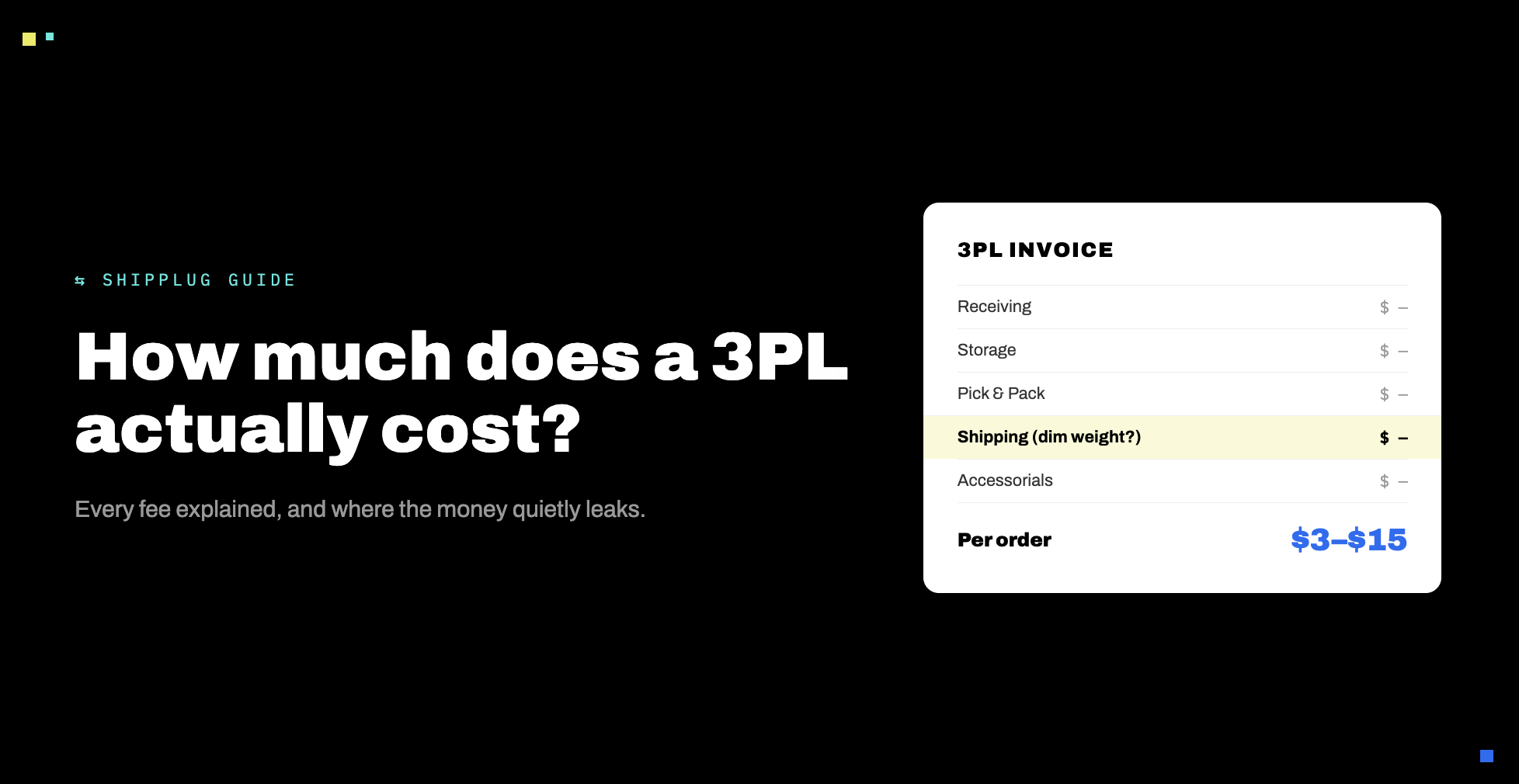
Most brands pay somewhere between $3 and $15 per order all in, once you add up storage, receiving, pick and pack, and shipping. Where you land depends on your volume, your product, and how your contract is written.
That range is wide for a reason. Two brands shipping the same number of orders can pay very different amounts based on how their fees are structured. The number on the last line of your invoice matters less than the fees that build up to it.
The core fees, one by one
Receiving
What it is: the cost to unload your inbound inventory, count it, and put it away. Usually billed per pallet, per carton, or per unit.
Where it leaks: brands often get charged both an "inbound handling" fee and a "receiving" fee for the same work. Consolidating your inbound shipments cuts this line down.
Storage
What it is: the cost to hold your inventory. Typically billed per pallet, per shelf, or per bin per month. Common ranges run from single digits to a few dozen dollars per pallet per month.
Where it leaks: slow-moving inventory sitting in premium space, and long-term storage fees that escalate the longer stock sits. Storage is where dead SKUs quietly eat margin.
Pick and Pack
What it is: pulling the items for an order and packing them to ship. Often the single biggest per-order line. Frequently in the low single digits to mid single digits per order.
Where it leaks: extra per-item pick fees on multi-item orders, and packing fees that appear twice under different names, like "fulfillment fee" and "order processing fee."
Shipping
What it is: the carrier cost to get the order to your customer, usually passed through with a markup.
Where it leaks: dimensional weight. When packaging is bigger than the product needs, the carrier bills on box size instead of actual weight, which can inflate the shipping cost on lightweight items significantly. This is one of the most common places brands overpay.
Accessorials and Surcharges
What it is: the extras. Kitting, returns processing, special handling, peak-season surcharges, and more.
Where it leaks: charges applied outside what your contract actually allows, and peak surcharges that show up without warning.
Two ways 3PLs price the whole thing
Itemized. You pay a separate line for each activity: receiving, storage, pick, pack, ship. More transparent, easier to audit, easier to negotiate.
Percentage of order value. The 3PL takes a cut of each order, often in the range of a low double-digit percentage. Simple on the surface, but it can quietly cost more as your average order value rises, and it hides which activities actually drive your cost.
If you are on a percentage model and growing, it is worth modeling what an itemized structure would cost. The simpler bill is not always the cheaper one.
What drives your number up or down
- Volume. More orders usually means better per-order rates, and volume is your strongest lever in any negotiation.
- Product profile. Light and small is cheap. Heavy, fragile, oversized, or temperature-controlled costs more.
- Order complexity. Single-item orders are cheap to pick. Bundles, kits, and multichannel orders cost more.
- Contract terms. Minimums, storage escalators, and rate-increase clauses can swing your total more than the headline rates.
How to Tell If You are Overpaying
Line up your invoice against your rate card and check three things. Do the charges match what you agreed to. Are any activities billed twice under different names. Is your shipping cost inflated by oversized packaging. Most brands who look closely find real money in the first pass.
If you would rather not do it line by line yourself, that is exactly the work we do. We read your 3PL invoices, find what you are overpaying, and cut it down, without you switching providers.
FAQ
What is a fair per-order cost for a 3PL? Most brands land between $3 and $15 per order all in, depending on volume, product, and contract. The all-in number matters less than whether each underlying fee is fair.
Is percentage-of-order pricing better than itemized? It is simpler, but it can cost more as your average order value grows and it hides what is driving your cost. Itemized pricing is easier to audit and negotiate.
What is the most common way brands overpay a 3PL? Dimensional weight from oversized packaging, and duplicate fees for the same activity billed under two names.
Can I lower my 3PL cost without switching providers? Yes. Most of the savings is in the bill you already get, not in changing warehouses. That is the core of what ShipPlug does.
Want to know what you are overpaying right now? Send us your 3PL invoices and we will show you where the money is.