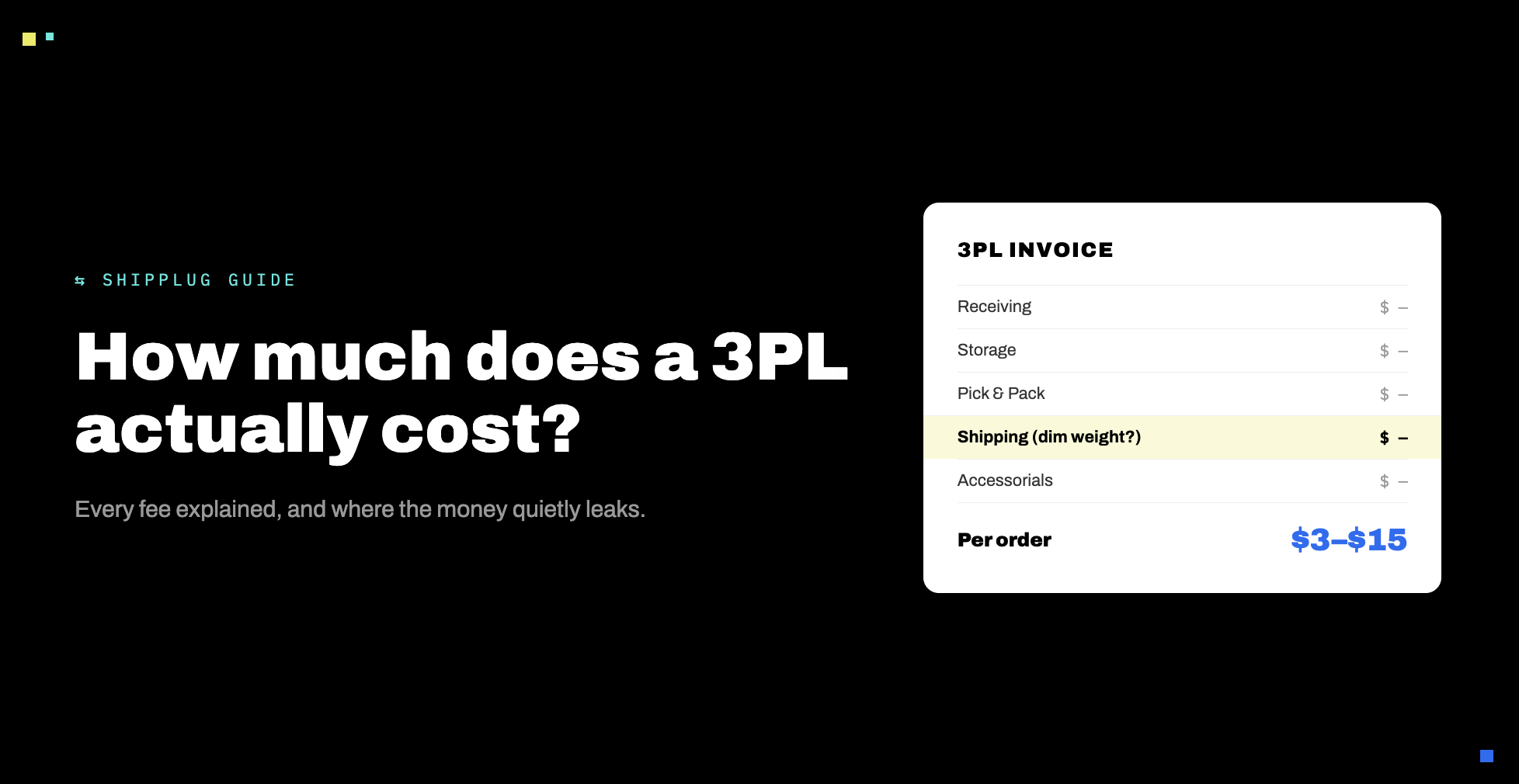



Your 3PL invoice is designed to be paid, not read. The charges are spread across line items in language only the warehouse fully understands, and most brands approve the total without checking the parts. That is exactly where the overpayment lives.
Here are the fees that most often drain margin, why they happen, and a checklist you can run against your next invoice.
The Usual Suspects
Dimensional weight
The single most common overcharge. When your packaging is larger than the product needs, the carrier bills based on the box dimensions instead of the actual weight. On lightweight items, that gap can inflate the shipping cost substantially. You are paying to ship air.
Fix: right-size your packaging and set cartonization rules so orders go out in the smallest box that fits.
Duplicate fees under different names
One activity, billed twice. A single pick-and-pack can show up as both a "fulfillment fee" and an "order processing fee." One received pallet can generate both an "inbound handling charge" and a "receiving fee." Individually small, but multiplied across your order volume it is real money.
Fix: map each activity to a single charge and flag anything that appears more than once.
Storage creep
Slow-moving inventory sitting in premium space, plus long-term storage fees that escalate the longer stock sits. Dead SKUs quietly rack up storage while you are not looking.
Fix: review inventory age, clear or relocate slow movers, and watch for escalating long-term storage rates.
Accessorials applied outside your agreement
Special handling, address corrections, peak surcharges, and other extras that get added even when your contract does not clearly allow them, or at rates above what you agreed.
Fix: check every accessorial against your contract. If it is not in there, it is a conversation.
Receiving and handling padding
Extra fees for unloading, counting, and putting away inventory, sometimes split into multiple charges for what is really one job.
Fix: consolidate inbound shipments to reduce per-pallet and dock-time fees, and challenge split charges.
The Checklist
Run this against your next 3PL invoice.
 Every line item traces to a specific charge in your contract or rate card
- No activity is billed twice under two different names
- Shipping charges reflect actual weight, not oversized-box dimensional weight
- Storage matches your real occupied space, with no surprise long-term escalators
- Every accessorial and surcharge is allowed by your agreement
- Receiving is billed once per inbound, not split into overlapping fees
- Any rate increase since last period was agreed to, not silently applied
Most brands who run this the first time find charges worth challenging. The fees are not always errors. Sometimes they are just terms nobody pushed back on.
When it is worth bringing in help
Doing this once is manageable. Doing it every month, across thousands of orders, while running the rest of the business, is not. That is the gap we fill. We audit your 3PL invoices line by line, find what you are overpaying, and cut it down, without you changing providers.
FAQ
What is the most common 3PL overcharge? Dimensional weight from oversized packaging. When the box is bigger than the product needs, you pay carrier rates on the box, not the contents.
How do I find duplicate fees on my invoice? Look for the same activity described two ways, like a "fulfillment fee" and an "order processing fee" for a single pick-and-pack, or "inbound handling" plus "receiving" for one pallet.
Are hidden fees the same as billing errors? Not always. Some are genuine errors, but many are just terms that were never questioned. Both are worth challenging.
Can I get overcharges credited back? Often, yes. Once you identify a charge that does not match your agreement, it becomes a negotiation for a credit and a corrected rate going forward.
Stop approving invoices you cannot read. Send us your 3PL invoices and we will show you where the money is.